There are a great many types of spruce tree, and while many variations can be found in urban ornamental settings, the most common spruce in Saskatchewan is the white spruce.
Growth Patterns:
White spruce grows to a height of 40-60 feet, and when mature has a spread of 10-20 feet. It grows at a medium rate with a height increase of 13-24 inches per year.
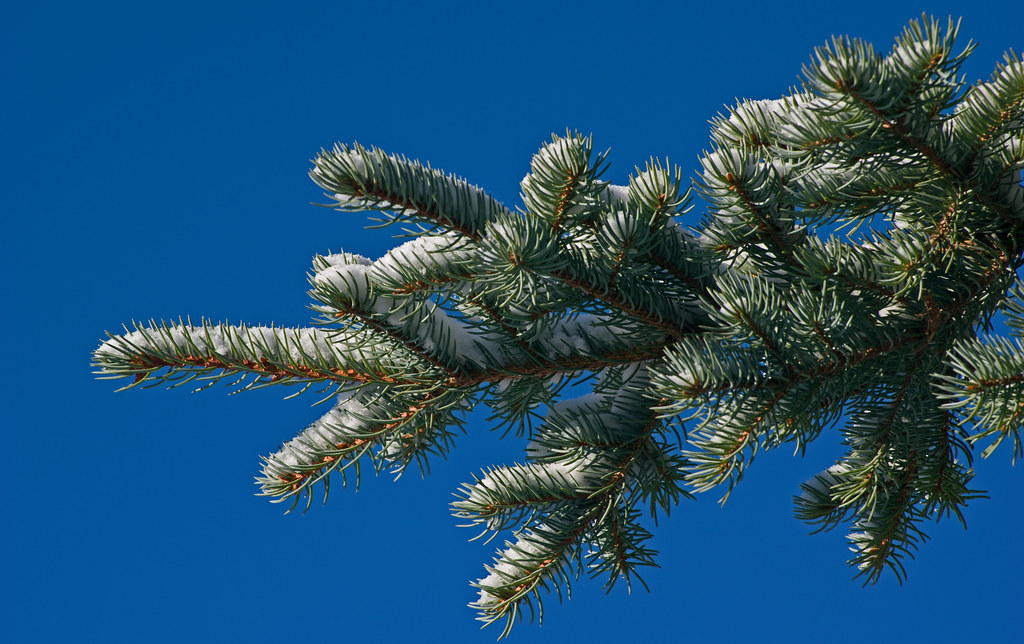
Spruce trees are a of the genus Picea, a genus of about 35 species of coniferous evergreens in the family Pinaceae. To clarify, an evergreen is a plant has foliage that is active over more than one growing season. A conifer in the most simple sense is a plant that bears cones for reproductive purposes.
During the course of my study I learned that spruce trees have both male and female cones. The female cones typically occur on the top 1/3 of the tree, while male cones appear distributed throughout the tree. Male cones are responsible for pollination, which is achieved primarily through wind and physical disturbance. While the female cones appear large and dense, I have found (in my limited experience) male cones to be smaller and more fragile.
It is difficult to describe a great deal of features without getting into specific varieties of spruce. The common traits: foliage is needle like, and each needle is attached directly to the branches. The needles are sharply pointed, square, and roll between fingers. This trait makes it easy to differentiate between spruce and fir. A fir needle is flat, and will not roll between fingers.
White spruce is said to to be the provinces largest tree, and most used timbre resource. Black spruce is very common in the northern boreal forests. Ornamental varieties are sold in numerous varieties by local tree nurseries, and identifying species growing in a landscaped area will be significantly more difficult than identifying native varieties.
Reference:
https://www.arborday.org/trees/treeguide/treedetail.cfm?itemID=927
 The Wild
Leave a comment