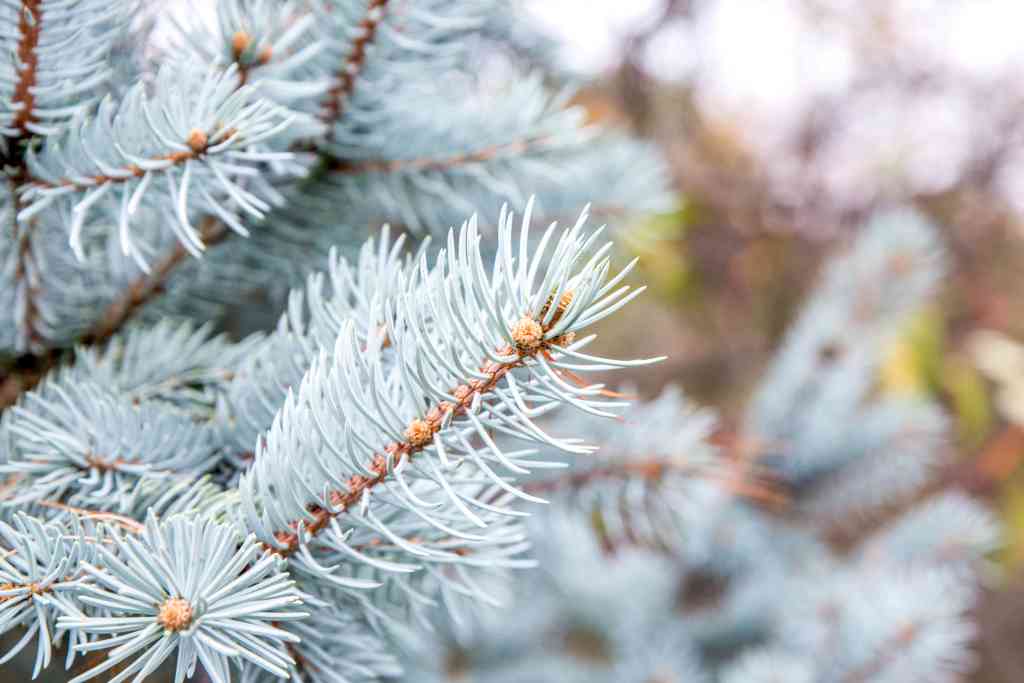
Order: Pinales – Family: Pinaceae – Genus: picea – Species: P. pungens
Growth Patterns: reaches 60-80 feet in height, and will have a 40-70 foot spread when fully grown. Canopy is conical with dense horizontal branches.
Leaves: Evergreen needles are silvery blue-green and 1-1.5 inches stiff with sharp points. Attached individually at right angles to the twig. Aromatic if crushed.
Flower: Male cones emerge purple and ripen to yellow brown. Male cones appear throughout the canopy.
Fruit: Female cones are 2-4 inches, cylindrical, light brown with flexible scales. Female cones appear at the top of the tree.
Bark: Greyish brown, flaky or scaled.
Distribution: Native to North America growing naturally in USDA zones 1 through 7. Although the blue spruce is native to portions of the United States its hardiness and cold tolerance has made it popular in Canada even among the coldest regions.
Habitat: According the the USDA information on soil preferences for the purpose of silvicultural decisions is limited. More information
Uses: Useful as a natural windbreak. Medicinal/food uses are limited. My favourite is to use the young shoot tips in spring to make a tea that is rich in vitamin C. This tea can be made from other spruce shoot tips.
Notes: When researching anti-desiccant products I found that they are not suitable for use on trees evergreens with waxy coatings on their foliage ie. blue spruce. If I understand correctly the blue-green colour of the needles is due to a ways coating.
 The Wild
Leave a comment