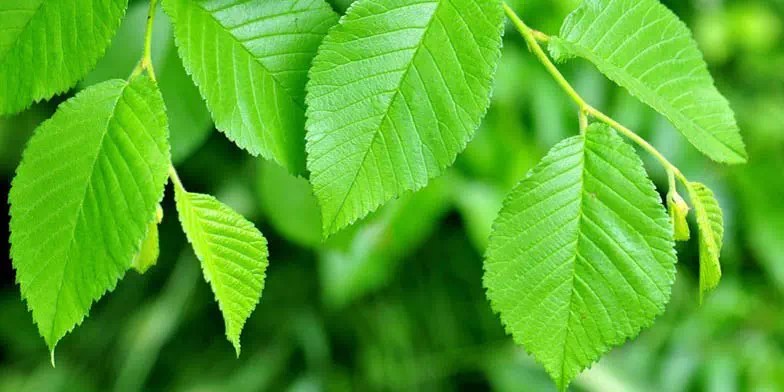
Image: https://www.honey-plants.com/calendar/virginia/american-elm/
Order: Rosales – Family: Ulmaceae – Genus: Ulmus – Species: Ulmus Americana L.
Growth Patterns: American elm will grow to a height of 60 – 80 feet and a spread of 40 – 70 feet.
Leaves: Dark green oval shaped 3″ – 6″ with alternating simple arrangement. Serrated edges. Golden yellow in the fall.
Flower: Hanging clusters of 15, small green-yellow with red spots
Fruit: Winged seeds, round, flat and hairy
Bark: Grey or brown colour, develops diamond shaped furrows as it ages. Cross section of bark shows it to be wafer like.
Distribution: Native to Canada, found across the Southern and Eastern portions. Can be found as far west as Saskatchewan.
Habitat: Prefers full sun but can tolerate some shade. Rich moist sites with good drainage, but tolerant to a variety of soils.
Uses: Most notable as a shade tree that was very popular in urban developments prior to the arrival of dutch elm disease. Medicinal uses include using extracts as a demulcent, an astringent, a diuretic, and for inflammation, burns, cold sores, and wound treatment. Most medicinal value is associated with the bark. See here for suggested applications.
Notes: It is noted that the American elm (white elm) is hardy to the following zones: 2a, 2b, 3a, 3b, 4a, 4b.
References:
- https://gardening.usask.ca/articles-and-lists/articles-plant-descriptions/trees/elm.php
- https://treecanada.ca/resources/trees-of-canada/white-elm-ulmus-americana-2/
- https://tidcf.nrcan.gc.ca/en/trees/factsheet/76
- http://www.naturalmedicinalherbs.net/herbs/u/ulmus-americana=american-elm.php
- https://www.ag.ndsu.edu/trees/handbook/th-3-113.pdf
 The Wild
Leave a comment