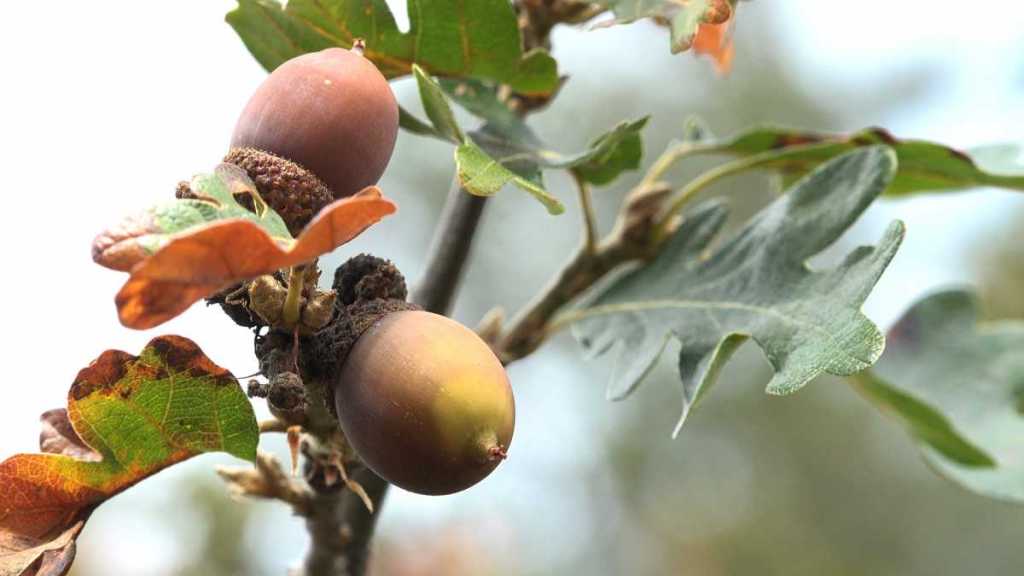
- Scientific Name: Quercus garryana
- Common Uses: Ornamental tree valued in both natural and landscaped settings.
- Maximum Height/spread: Garry Oak is a tall shrub to small or medium sized tree (>30m) with a broad rounded crown.
- Maximum age: 200 years
- Foliage Description: Thick stiff leaves with 5-7 rounded lobes separated by deep narrow notches. Upper surface appears pebbly, lower surface hairy (brown hair). They grow to a length of 7-10cm (3-4 inches). The upper leaf surface is dark green, the lower is a dull yellow green. In the fall leaves may turn red.
- Flower Description: the Gary Oak is monoecious. pollen flowers are small and appear in many flowered drooping catkins. Seed flowers are small and appear individually or in few flowered clusters (spikes).
- Fruit Description: Acorns solitary or pairs. The cup is shallow and saucer shaped, enclosing one third of the acorn. Measure 25-30mm in length. Short stems up to 5mm.
- Bark Description: Dark greyish-brow, scaly with narrow shallow furrows.
- Hardiness Zone: USDA hardiness zones 7a, 7b
- Soil Preferences: deep moist loamy soils, often at forest edge on south facing slopes.
Notes: very small range in Canada, confined to the West Coast, primarily on Vancouver Island. Considered to be an endangered species in Canada. It is the only oak native to British Columbia. Although not used for timber, the Garry Oak is valued for its visual appeal, and as a natural food source for numerous species of wildlife. Its deep tap root and strong lateral roots make it a capable wind break.
Image credit: http://vancouverislandtreestories.ca/tree-stories/garry-oak/
 The Wild
Leave a comment