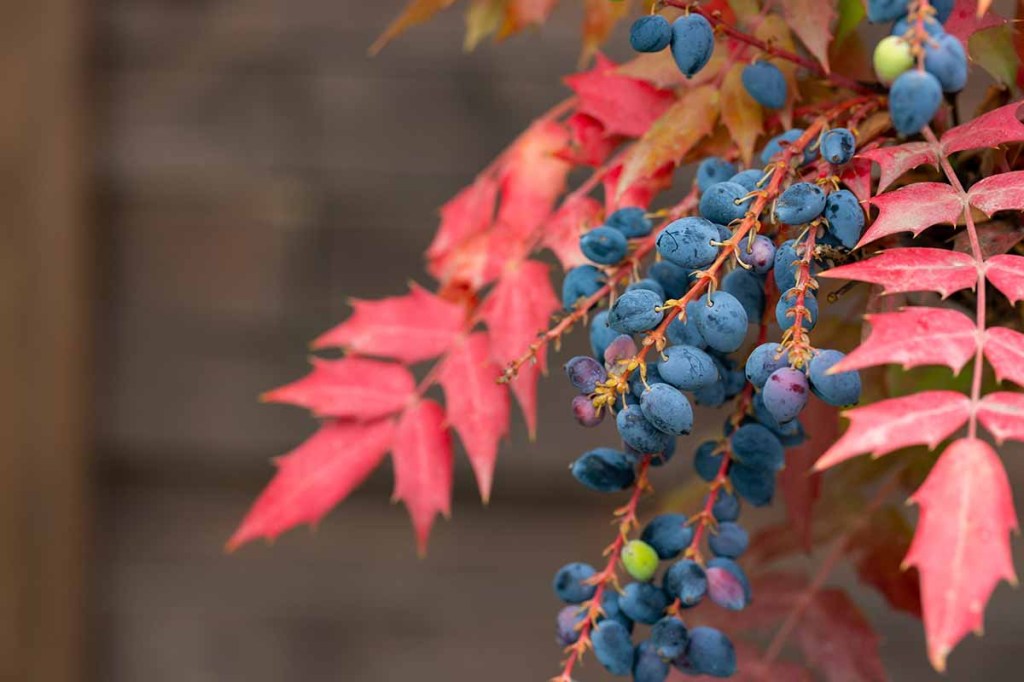
Our new home has provided me with access to some great hiking areas, and as a newcomer I am continually fascinated by the variety of plants that are found here. Last week I wrote about the Arbutus tree after coming across them on a couple of hikes. This week Oregon Grape was identified on the trail, and I decided it would be an apt subject for study, especially as its something I have seen on health food shelves many times, and which I have used in the past to treat fungal invaders in my microgreen growing experiments.
The Oregon Grape was discovered about two hours into a five hour hike when it caught my attention. I thought it was Holly, as in; “deck the halls with boughs of holly.” “Oh that is Oregon Grape” a hiking companion corrected me.
There are several varieties of Oregon Grape but we will focus on Tall Oregon Grape.
- Scientific Name: Berberis aquifolium
- Common Uses: Warning: berries may be toxic and even deadly in large quantities. Berries can be eaten or used for flavoring, but not in quantity. The Bark, root and rhizome have been used in traditional medicine to treat psoriasis, eczema, stomach conditions and other afflictions. Additionally these compounds can be used to treat bacteria and fungal infections. One of the compounds “Berberine” has both antimicrobial and anti-inflammatory properties.
- Maximum Height/spread: Grows between 1-3 meters tall (3.5ft – 10ft) and 1.5 meters (5 feet) in spread.
- Maximum age: productive life span is estimated to be 5 – 20 years.
- Foliage Description: Pinnate compound leaves, beginning coppery or bronze and then turning a deep green with orange, purple, or red highlights in very sunny or cold conditions. Leaves up to 30cm (12 inches) long and comprised of spiny leaflets.
- Flower Description: Yellow flowers in dense clusters late in the spring.
- Fruit Description: Frosted blue grapes (berries) appear in summer.
- Bark Description: n/a
- Hardiness Zone: Zone 5A (BC Native)
- Soil Preferences: prefers well drained soils, but drought and moisture tolerant. Does best in full sun or dappled shade.
From a personal standpoint, I have used Oregon Grape oil in an attempt to remove a fungus infestation of my experimental microgreen plots. The problem with the product I used was that the extract was highly viscous, and it was very difficult to apply it in an even manner to the infection points. In the future I would likely seek a way to dilute the concentrate for easier application.
As a side note I am currently dealing with a case of angular cheilitis which has been persistent and resistant to my treatment attempts. This is a new problem for me, and among the many potential causes are bacteria or gut flora imbalance. Given the medicinal properties associated with Oregon Grape I am intrigued by a potential application in my situation.
The main concern with this is of course the suitability of such extracts for internal use, especially knowing that there are potential toxicity issues related to the plants berries. I would likely apply it topically, but the affected area is the mouth and lips so I need to do more research and or speak to a professional before I attempt it.
Reference:
https://gardenerspath.com/plants/ornamentals/grow-oregon-grape/
https://froemkelab.med.nyu.edu/surgery/content?ChunkIID=21828
https://bcinvasives.ca/play-your-part/plantwise/grow-me-instead/tall-oregon-grape/
https://www.wnps.org/blog/tall-oregon-grape-mahonia-aquifolium
https://www.healthline.com/nutrition/oregon-grape#what-it-is
https://www.northernbushcraft.com/topic.php?name=oregon+grape®ion=bc&ctgy=edible_berries
 The Wild
Leave a comment