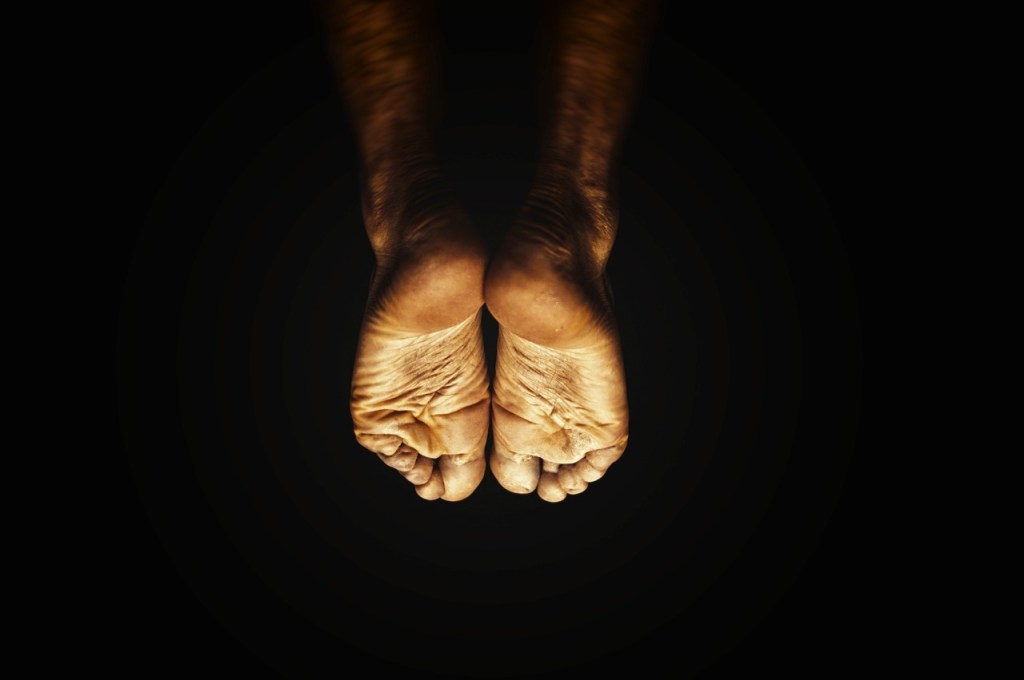
Over the years I have met several people who struggle with foot pain. Not only is this frustrating as pain saps the joy from otherwise pleasant activities, but it can eliminate our participation altogether. As someone who has dealt with with my own foot pain for years I thought I would share what has worked for me.
Fifteen years ago I was clinically obese, over medicated, and so ill that I could barely walk around the block. The problem was not only in my terrible cardiovascular condition, but in my feet themselves. Walking even short distances caused me terrible foot pain, and running had been out of the question for years.
The issue of weight was certainly a factor, but my foot problems had begun in my early twenties when I purchased some rigid hiking boots for daily wear. The pain came on gradually, but by the end of the summer it was beyond tolerable. At first I only noticed it when I was walking on hard surfaces such as concrete and packed earth. Then I started to feel the ache even when I was on softer and natural surfaces. The lesson was learned. I got rid of the boots at the end of summer, but the pain stayed.
What do I mean by rigid boots? At that time there was a trend towards inflexible boots for hiking and mountaineering. The boots were designed to be nearly indestructible, trading flexibility for durability. Instead of allowing your foot to flex while walking, the boot was designed to create a rocking motion. The idea was to strike with the heel, and then roll the foot foreword. Perhaps there is (or was) a use for such designs in alpine environments, but I hope that the footwear industry has moved on altogether.
More than a decade later my focus changed a health centered lifestyle. I began to learn about footwear just as there was a major shift in the industry. To me the idea that we are meant to walk barefoot seems scientifically laudable according to the notion of evolution. As I read articles I began to ask myself if maybe the shoes I was wearing were part of the problem. What about my orthotics, and why did most of the people I knew have them? Was there a wholistic approach to my foot pain? The questions kept piling up.
The barefoot argument is simple. Human beings lived and thrived for thousands of years before the invention of modern shoes. The basic premise: in some cases modern foot wear is causing the problem rather than correcting it. This was logical, simple, and appealing to my mind. I began to look at more research and eventually found the work of several pioneers in the field of barefoot running. As someone living in a northern environment, shoes were a necessity, so I started to look into the options available to me.
The very first barefoot equivalent shoe to get widespread attention was called the vibram five finger. I tried a few pair, but none fit my foot well. Fortunately at that time a few large manufacturers had began to bring “barefoot equivalent” shoes to market. I did some research, and spoke with experts to determine what I should be looking for.
A barefoot equivalent shoe should have four features:
- A wide naturally shaped toe box
- Flat: often referred to as zero drop. This means the heel is not raised up.
- Flexible: the shoes should allow natural bending and movement of the foot
- Thin sole: allows better ground awareness
Going to a barefoot equivalent shoe turned out to be a very good choice for me. The pain was not magically cured, rather the shoes taught me how to properly walk and run. I had to work on my gait, but over time I did improve, and with the changes my pain also faded and eventually disappeared.
Over the last 15 years I have tried barefoot shoes for everything. Walking, running, international travel, and long distance trekking. In almost all cases I have found them to be the superior choice for my foot health and performance. If there is one caution I would provide it is this: barefoot equivalent might not be the best choice for high levels of activity in urban environments. The minimal amounts of cushioning are better for natural surfaces, and not as well suited to the continuous concrete we subjected to during activity in urban environments.
I would encourage anyone with foot pain to consider my success. Barefoot shoes helped me correct my foot pain, but only after my health was restored, and I had moved from a BMI of 32 to a BMI of 22.
Below you will find a few resources that may be of use. As always – Stay Wild!
Born to Run – Christopher McDougall (chrismcdougall.com)
Study: Humans Were Born To Run Barefoot : NPR
 The Wild
Leave a comment