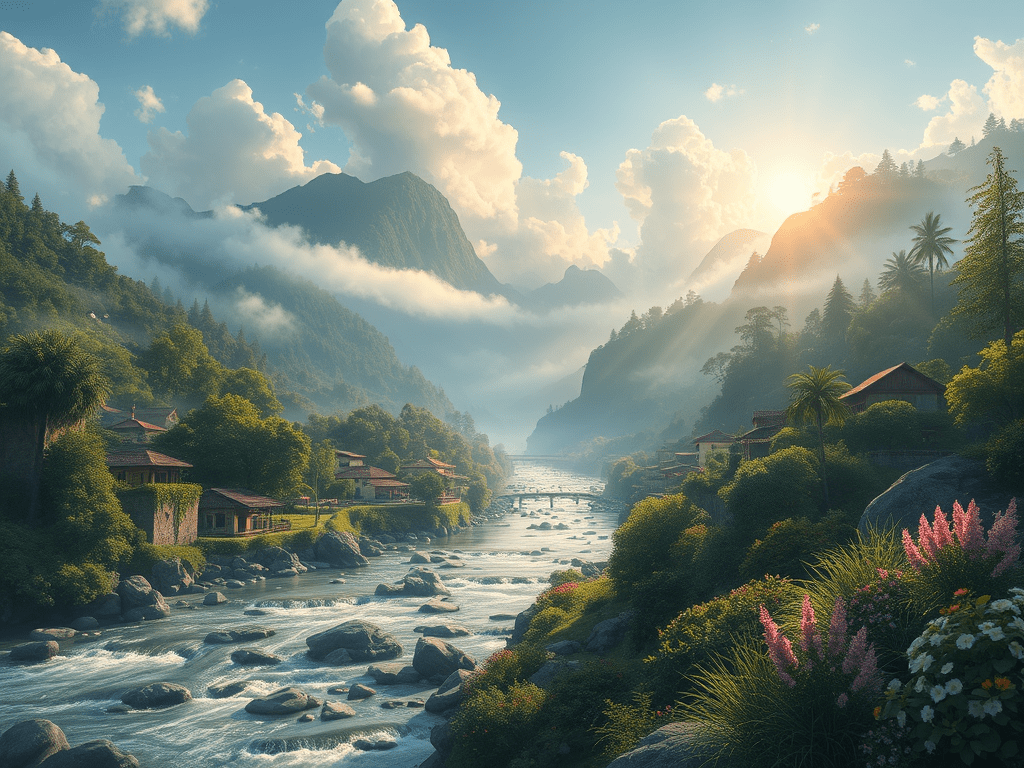


Very hard choice. Let me tell you about paradise.
Paradise is a zone more than a place. At least this is true if we are talking about climate. Falling back on my geography education, I can tell you that the zone is classified as “Subtropical Highland Climate” or Cwb according to the Koppen Climate Classification system.
Areas that fall in this climate class are often said to exist in a state of eternal spring. When I think about the Cwb climate, there is a very special place that comes to mind. It is a small town that rests upon the banks of a mountain river in Panama. It is relatively close to the equator, and would be tropical but for the altitude. Sitting at 1200 meters (3900 ft) it is located at an almost perfect elevation.
The benefits of being at elevation in the tropics are many. First it mitigates the heat. Second there are less problems with biting insects and contagious disease. Third it provides natural protections against natural disaster. Then there is the clean air and pure mountain water.
What I recall about my time in the Panama highlands was the nearly perfect weather patterns. Every morning began with a very light rain shower. I would wake up to a town that had been gently washed in the early hours. The humidity was perfect, and everything was fresh and vibrant. The locals had a name for this phenomenon, but it escapes me. This would be followed by sunshine and pleasant weather daily, with average temperatures around 25C (77F).
Close to the equator day length does not fluctuate as we experience it in the polar regions. There are 12 hours of light, and 12 of dark. This means that the slopes and valleys are almost always green and flowering. The growing season never stops. Eternal spring.
It is also completely out of reach for most of us. The barriers to entry are many, and sometimes not clearly defined. Many people move thinking they will retire in paradise, only to find a system that they cannot navigate. Most end up returning home, some of them are not ruined financially.
In North America I would probably be drawn to the Ocean. This is true the further you get into the norther extremes. The main factor is again climate. In Canada for example, temperatures are kept to reasonable levels so long as you stay close to the ocean. As soon as you move inland, the extremes of winter can become very inhospitable. It is all about the oceans ability to act as a heat sink. It means that even at northern latitudes areas close to the ocean will be much warmer than those inland.
I will admit that I enjoy the geography of mountains. The epic scale, and potential for adventure seem omnipresent. In the mountains you have access to nature untamed. Areas that are not owned, nor surveyed. You can choose a direction, start walking, and there is a decent chance you wont be trespassing or climbing over fences with not enter signs. This is a rare find in a world of overwhelming humanity.
I guess I will sum up by putting it this way. Ocean in the winter, mountains in the summer. Or – what about mountains by the sea? Best of both worlds if you ask me.
Live Free, Stay Wild.
 The Wild
Leave a comment