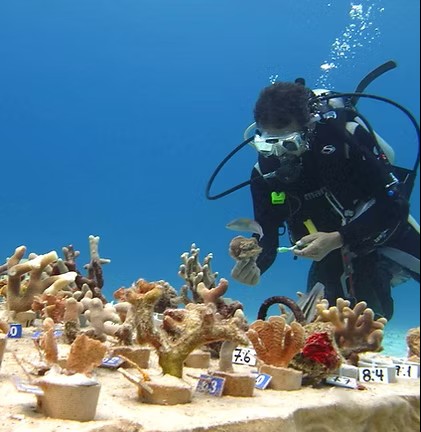
I went to Mexico with a purpose: to learn more about coral reef ecosystems and find a meaningful way to contribute to their preservation.
As I grow older, I find myself drawn to investing my philanthropic energy in the environment. I’ve been involved in humanitarian projects in the past, but increasingly the natural world is where I feel called to focus. As a lover of the water and a longtime SCUBA diver, seeking out a reef restoration project felt like a natural next step.
My first choice was Roatan, Honduras — the site of my first open water dives. Returning there felt poetically right, a chance to witness firsthand how things had changed over the years. Unfortunately, time and financial constraints made the trip impossible on this occasion.
Instead, I found a comparable project in Cozumel, Mexico, far more accessible and equally compelling. The organization is called the Cozumel Coral Reef Restoration Program, founded in 2017 by Dr. Mendez, who continues to lead it today. You can find more information about the program here.
In hindsight, Cozumel may have been the better choice all along. Dr. Mendez is not only deeply knowledgeable and passionate about his work — he has also built something remarkable: a well-established program supported by an entire team of dedicated volunteers from around the world.
I enrolled in the “Coral Reef Conservation Course,” offered on a weekly basis. On the first day I was joined by two fellow students, one from the United States and one from France. We spent several hours learning about coral biology and the impact of local industry on reef health before heading into the water for the first of three dives spread across two days.
One practical note worth mentioning: shore diving demands more physical effort than boat diving. While the school and dive shop are situated close to the water entry point, it still requires walking 15–20 meters to reach a concrete stairway leading down to the sea. One of the older participants in our group found this portion of the experience challenging. Anyone with mobility limitations should factor this in before enrolling.
The two-day course moved quickly. We covered coral identification, cleaning techniques, and planting methods, and upon completion received a PADI-recognized certificate that qualifies graduates to continue this work in the future. We were also encouraged to volunteer with the organization going forward.
Before leaving, I connected with several other volunteers and joined the CCRRP volunteer group, which is wonderfully active. I didn’t have the opportunity to volunteer beyond the training itself on this trip, but I now have the knowledge, the credentials, and the contacts to return and contribute more meaningfully.
The experience was excellent. My intention is to go back — ideally for one to two months each year — rent an apartment with a fellow volunteer or two, and spend as much time in the water as I possibly can.
Stay Wild.
Reference:
Coral Reef Resource: https://coralpedia.bio.warwick.ac.uk/
CCRRP Story: https://youtu.be/lIUJa8MLqQg?si=nYbkVAe7dwVlChsY
 The Wild
Leave a comment