
I recently hiked a regional park that contained several magnificent Arbutus stands. The Arbutus is Canada’s only native broad leaf evergreen, and is quite a sight to behold in the fall when it sheds its bark revealing smooth younger bark underneath that can be from pale green to cinnamon-red.
- Scientific Name: Arbutus menziesii
- Common Uses: Traditionally the bark was used for tanning, and sometimes combined with other ingredients to treat colds, stomach problems, and as a post-childbirth contraceptive, as well as in 10 bark medicine for tuberculosis and spitting up blood.
- Maximum Height/spread: Up to 30 meters high, irregular crown.
- Maximum age: speculated between 250-400 years.
- Foliage Description: dark green glossy leaves, pale underneath. Oval 7-12 cm long, thick and leathery. Young leaves can be serrated.
- Flower Description: Dense clusters of white urn shaped flowers found drooping at the end of twigs.
- Fruit Description: Berries that are 7mm across and a bright red-orange with a peel like surface. Not usually consumed by people, but popular with birds.
- Bark Description: smooth and reddish brown. Peels in thin flakes or strips revealing younger bark underneath that is smooth, and greenish to cinnamon red in color.
- Hardiness Zone: USDA hardiness zone 8
- Soil Preferences: sites that lack moisture, often in rocky and rapidly draining soils.
Straits Salish story: the Arbutus tree was used by survivors of the Great Flood to anchor their canoe to the top of Mount Newton. To this day the Saanich people do not burn the Arbutus in their stoves, because of the important service the tree provided long ago.
Straits Salish myth: Pitch used to go fishing before the sun rose, and then retire to the shade before it became strong. One day he was late and had just reached the beach when he melted. Other people rushed to share him. Douglas-fir arrived first and secured most of the pitch, which he poured over his head and body. Grand fir obtained only a little, and by the time Arbutus arrived there was none left. Therefore arbutus has no pitch to this day.
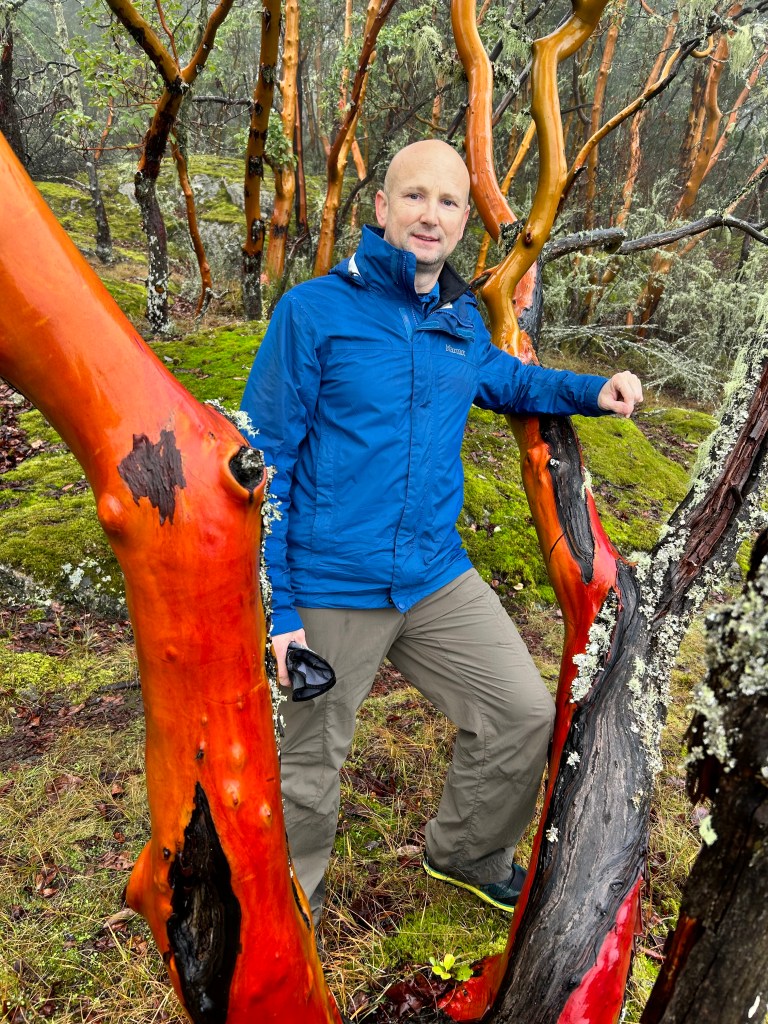
The author with a peeling Arbutus displaying vibrant cinnamon-red younger bark. This stand was among many found in the Mount Work Regional Park on Vancouver Island. Photo was taken on the first week of December 2023.
References
https://www.for.gov.bc.ca/hfd/library/documents/treebook/arbutus.htm
Pojar, J. (2004). Plants of Coastal British Columbia. Lone Pine Publishing.
Featured image courtesy of https://gardenshop.symbiop.com/
 The Wild
Leave a comment